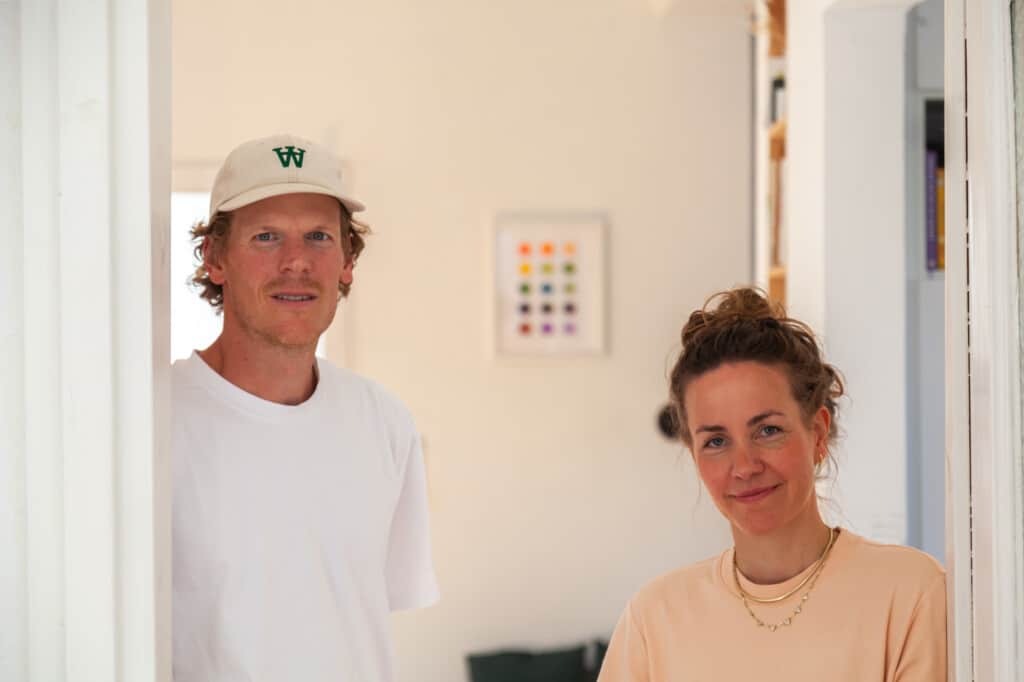
Lisa Keller and Fynn Freyschmidt, both born and raised in Berlin, met while studying at Berlin University of the Arts. Alongside their relationship, an involvement in each other’s work began to grow — although it would be several years before that collaboration officially took the name KellerFreyschmidt. Lisa feels most at home in the world of tableware, while Fynn’s work focuses mainly on furniture design and material innovation. Those different backgrounds come together in their designs, as well as in their collaboration with Vij5. Chaku has been part of the Vij5 collection since 2020, followed by Papeterie in 2026.
September 2026
Text: Daniëlle van de Haterd
Photography: Vij5


“There is no single right way to balance family life with a design practice.”
Lisa Keller

At the kitchen table
For this interview, Arjan and Anieke joined Lisa and Fynn at their kitchen table while their children played around them. It felt like an appropriate setting, because for KellerFreyschmidt, work and everyday life are constantly intertwined. Ideas emerge at home, prototypes are tested there, and inspiration for a good design is often found in the most ordinary moments of daily life.

“It is simply fun for me to find solutions to problems that occur every day.”
Fynn Freyschmidt
Growing up
Although Lisa and Fynn both grew up in Berlin, their surroundings were very different. Fynn’s roots are in a central part of the city, while Lisa lived on the outskirts, among horse farms. Yet despite that contrast, their childhoods had a great deal in common. Both grew up in warm, close-knit homes, with a strong sense of family and an attentiveness to the world around them.
Creativity also had plenty of room in both their childhoods.
In Fynn’s family, it was expressed mainly through music. His mother worked in a record shop and his father played guitar. At parties and family gatherings, making music together was simply part of the occasion. His grandfather left the most visible creative legacy: he drew and worked with clay in a distinctive style of his own. “Our family shares a holiday home on the Baltic Sea, and a lot of his work is still there. It’s lovely to come back and see it all again.”
Lisa did not grow up in a family of designers, although she is certainly surrounded by them now. Her brother became a graphic designer and her sister-in-law studied fashion design. “My father always says, ‘We’re not designers — we make designers,’” she says with a laugh.

What Lisa did inherit from her parents is their eye for quality and beautiful things. Fynn speaks fondly of his parents-in-law’s home, where beautiful, well-considered objects can be found everywhere. They are not necessarily all things he and Lisa would choose themselves, but they are objects that convey warmth, care and a sense of longevity.
One piece of furniture in particular stands out in Lisa’s memories: the round extendable table in the living room. “The feeling I associate with that table is togetherness. Most of the time we sat in the kitchen, but if we had a more elaborate meal or breakfast at the weekend, we would sit around that round table. That alone made those meals feel special.”

“A project often starts with play. At some point, we realize it has become interesting enough to turn into a product.”
KellerFreyschmidt
Never stop playing
For as long as she can remember, Lisa has loved to play. As a child, she could not imagine ever wanting to stop — although, of course, she did not want to embarrass herself either. So as a teenager, she turned everyday chores into games. “If I had to clear the table after breakfast, I would pretend I was a professional packer. I might wrap a piece of cheese in aluminium foil as beautifully as I possibly could. In my head I was incredibly good at it, and people would eventually pay me to make beautiful little packages out of their cheese too.”
For Fynn, play looked completely different. He was mostly outdoors and on the move: playing basketball and tennis, cycling, skateboarding and skating. Where Lisa invented worlds around the things she was doing, for Fynn, the activity itself was the game.


That playful instinct never really disappeared. Designing, too, often starts with a process of exploring and trying things out. “For me, design is both play and work,” says Fynn. “I like finding solutions to problems that come up in everyday life. I’ll quickly head into the workshop, build something and try it out. A lot of things in our home started that way, as quick solutions that might eventually turn into an actual design.”

“When too many people add their own spice, a project can become a soup of ideas. It still needs a direction.”
Fynn Freyschmidt
When play becomes work
Too much pressure or direction can limit that sense of play — and the enjoyment of designing — Fynn feels. “Some clients bring in so much of their own input that the design process starts to suffer. It becomes this big soup of ideas, and if everyone keeps adding ingredients, the original idea can get lost.”
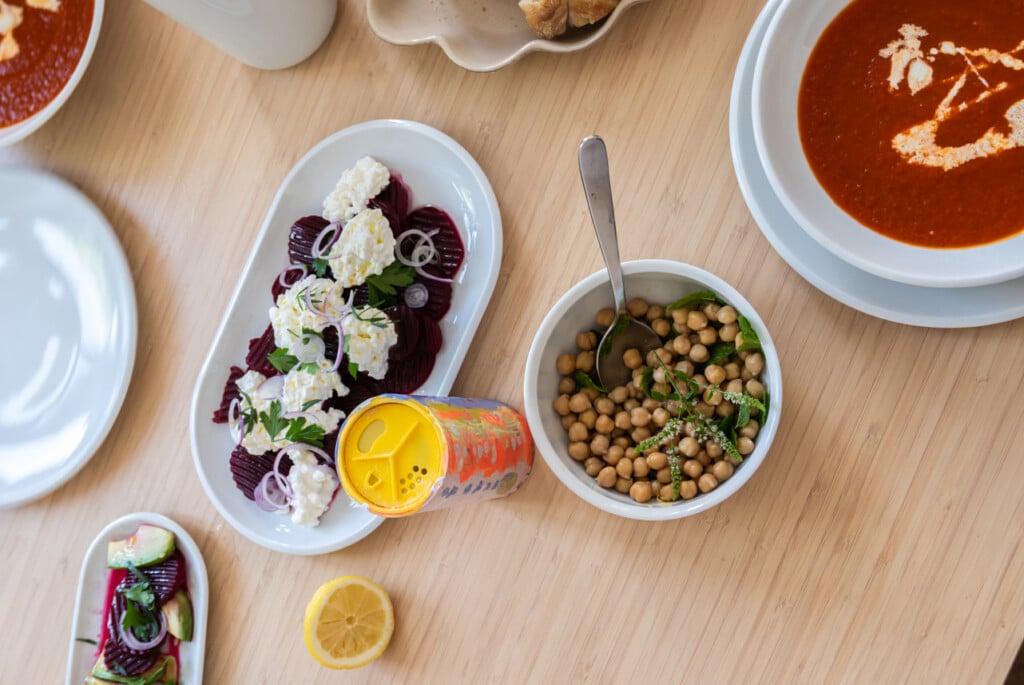
Coincidentally, Lisa and Fynn had served a delicious soup before the interview. Arjan points out that they had added all sorts of things to the original recipe themselves, including yoghurt, herbs and edible flowers — and the result was a wonderfully rich soup. So what made the difference? “There was one clear director,” Lisa says. “I decided which flowers went in.” Fynn laughs: “Yes, I wasn’t asked. The flowers were just there all of a sudden!”
They readily admit that cooking together is not always a resounding success. If they both keep adding something to a dish, it can end in a compromise that neither of them is particularly happy with. Designing together clearly works differently. There, they pass ideas back and forth. As they conclude themselves: they are better at designing together than they are at cooking together.

“Good design isn’t just about adding more luxury. It can improve our everyday surroundings and should be accessible to more people.”
Lisa Keller
Student days
Lisa and Fynn both studied at Berlin University of the Arts and met when Lisa was in her final year. Fynn helped her with her graduation project, and a year later she did the same for him. Critically reflecting on each other’s work has been part of their relationship from the very beginning.
Lisa went through her studies with plenty of doubts. Again and again, she questioned what a new product actually adds. At times she doubted it so strongly that she was not even sure she wanted to continue as a product designer. “I didn’t want to design just another luxury chair or stool. I wanted to do something that genuinely added value.”
A semester in Helsinki convinced her to stay in the field. “That’s where I realised there is value in simply having a well-designed world around you. Design is about more than luxury.”

While Lisa tended to approach design analytically, Fynn consciously gave himself room to experiment during his studies. He learned a great deal from classes taught by designer Axel Kufus, where the emphasis was less on reaching a finished product as quickly as possible and more on investigating, making and trying things out. It was an approach that suited him. “You could take a material or a technique and simply ask: what happens if I keep going with this?”
For his graduation project, Fynn chose a similarly experimental path. He explored air as a material — not necessarily starting with a specific end product in mind, but out of curiosity about what adding air could do to a material or technique.
That investigative approach is still visible in his designs today. Where Lisa often starts by asking how and why we use something, Fynn prefers to dive into the material and the workshop first, to see what might emerge from there.
A view on sustainability
The doubts Lisa had as a student have not disappeared entirely. The question of whether a new product genuinely adds something still plays an important role in the way she designs, although her perspective has changed. Not every product needs to solve a major social problem in order to have value. A well-designed object can be meaningful in other ways too.
For both Lisa and Fynn, sustainability starts with the decision to make something new in the first place. Is the product relevant? Does it add something to what already exists? Has real thought gone into how it will be used and how it will be made? For them, sustainability is therefore woven into the entire design process.
Lisa likes to begin with everyday life. Rather than automatically starting from an existing product category, she first takes the action itself apart. “With tableware, for example, you can ask: do we actually still eat at a table all the time? Maybe you’re more often sitting in a chair with a plate on your lap. Should that plate still look exactly the same?”
Fynn also likes to take existing things apart, but he tends to do so through materials and construction. By dismantling a product and studying how it is put together, new possibilities for form and use begin to emerge. In their own different ways, they are both looking for what is truly needed.

Two Perspectives
Although they form KellerFreyschmidt together, Lisa and Fynn rarely sit side by side working on the exact same design. Instead, they share ideas, respond to each other’s work and make use of the differences between their perspectives.
“Fynn has a good sense of what is interesting — or what could become interesting in the future. I tend to look more at the fundamentals: timelessness, use, and the question of what value something really adds,” Lisa explains.
Fynn, who says he can get lost in all the possibilities that emerge during the design process, trusts his wife’s critical eye. Even when he has already explored countless variations himself, he usually tries out her suggestions anyway. “Sometimes the conclusion is that I had already arrived at the best solution. But sometimes something new and better suddenly appears.”
Over the years, the way Lisa and Fynn work together has become so natural that they eventually decided to give it a name: KellerFreyschmidt.


“Lisa is always pushing to find out whether the shape already has the relevance it needs.”
Fynn Freyschmidt
Working with Vij5
Just as Lisa and Fynn’s own collaboration developed without a clearly defined plan, their collaboration with Vij5 came about in much the same way. In fact, everyone around the table has to think for a moment about how it started. Fynn may have discovered Vij5 through Hanne Willmann, whom he knew from his student days. “I think I noticed her collaboration with you and simply sent you a message. But to be honest, I’m not entirely sure anymore.”
The fact that no one at the table can quite remember the first encounter perhaps says more than anything about how organically the relationship developed from there.

What Lisa and Fynn particularly appreciate is that, with Vij5, a design does not have to be finished before the conversation can begin. Their own process already consists of ideas being ping-ponged back and forth, but sometimes the two of them reach a point where another opinion is useful.
“The two of us already have our own dynamic, but every now and then we get stuck between two options,” Fynn says. “That’s when a third perspective becomes really valuable. It’s also why we show things that are nowhere near finished yet.”
It helps that Arjan and Anieke each look at a design from a different angle. “You ask questions of each other too, just as we do,” says Lisa. “That extra perspective doesn’t take over the design; it adds another layer to the same process of testing, reflecting and adjusting.”
“A product cannot be separated from production, sales, and logistics. You need the full picture before you can say it’s ready.”
Lisa Keller
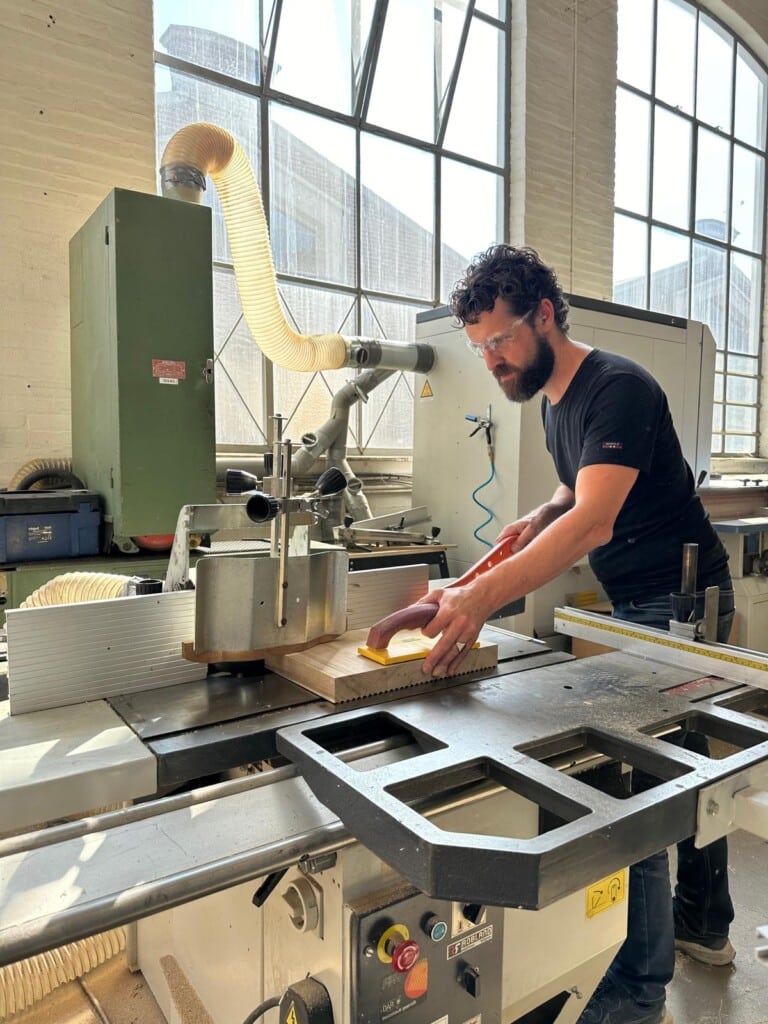
Fynn makes no secret of his enthusiasm for the way Vij5 works. “I like telling other people about the local production, where the materials come from, and the way the showroom, office and workshop are all connected.” For him, this contrasts with the anonymity he experiences at larger companies, where different parts of the process can be much further removed from one another.
Lisa recognises in Vij5 a way of working that is close to their own. “You can’t separate a product from how it is made and how it is sold. If you want to bring a good product to market, the whole picture has to work.” The fact that Arjan and Anieke are designers themselves helps too, she feels. “They understand where an idea comes from, while also bringing in their own knowledge and perspective.”

Chaku
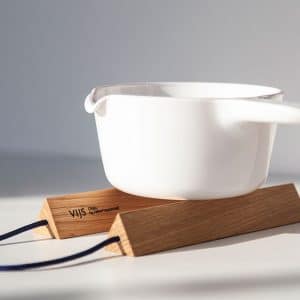
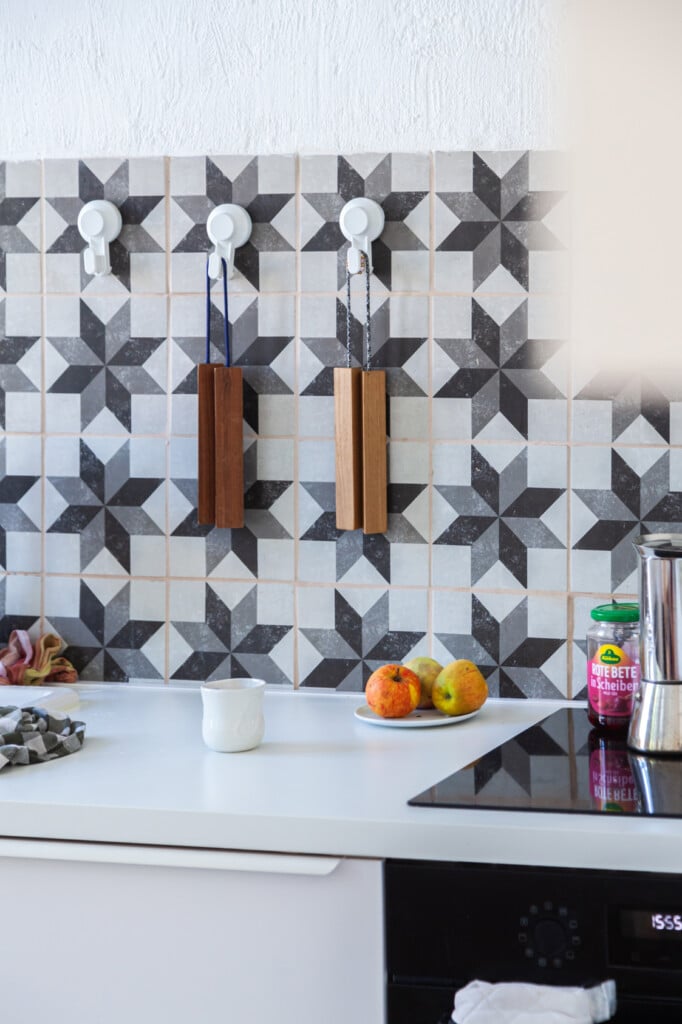
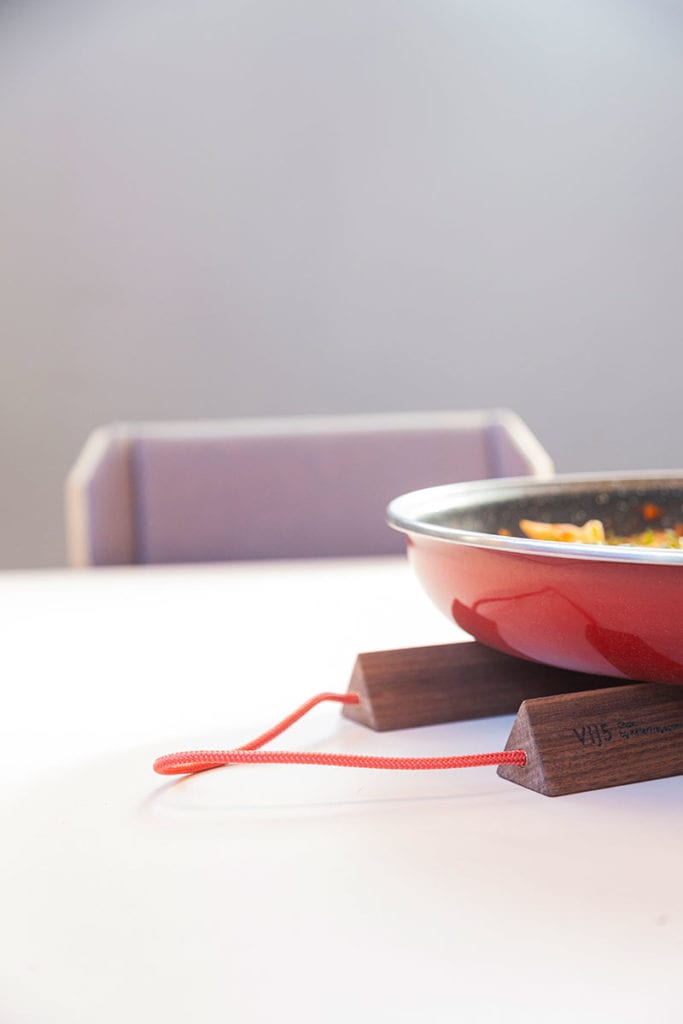
The Chaku trivet became their first product with Vij5 and has been part of the collection since 2020. It is a simple everyday object with something slightly enigmatic about it. Without a pan on top, its purpose is not immediately obvious to everyone; as soon as you use it, its function becomes self-evident.
The design started with Fynn, from a desire to make something in wood. For a long time, he experimented with different models made of interlocking pieces. “I had all these little shapes, but I still couldn’t see a real product in them.” Lisa, however, did see a possibility and eventually came up with the element that brought everything together: rope. “When she came up with that idea, I thought: yes, that’s good.”
Chaku makes very tangible what Lisa and Fynn mean when they talk about the relevance of a product. It is not only about form and use, but also about how something can be made. “There are so many layers to that product. The materials, the local production, the recycled rope that is produced in an energy-positive process. For me, all of that gives Chaku relevance,” says Fynn.
“Sometimes a product isn’t finished when we show it to you. Through reflection, we find more answers.”
KellerFreyschmidt

The value of a well-designed environment
But when is a design actually finished? Fynn prefers to test products at home over a longer period of time. Only when he realises there is nothing he misses or wants to change does a design feel complete to him. Lisa sees it slightly differently. For her, not everything needs to be predetermined for the user. “By leaving room for people to use an object in their own way, they can make it more their own and develop a relationship with it.”
Ultimately, what matters to her is what a design adds to everyday life. “If I design a glass, I’m perfectly happy if someone drinks water from it one day and serves soup in it the next. Why would I tell them they can’t?” She connects this to an insight she gained during her semester in Helsinki: the environment you live in affects how you feel. “Everyday objects that work well and are made with care contribute to a sense of home.” For Lisa, the value of design is therefore not only in the object itself, but above all in the place it comes to occupy in someone’s life.
Papeterie
Where Chaku began as an exploration of material and form, Papeterie grew out of a very ordinary phenomenon: the piles of books and magazines that seem to spread through a home all by themselves.
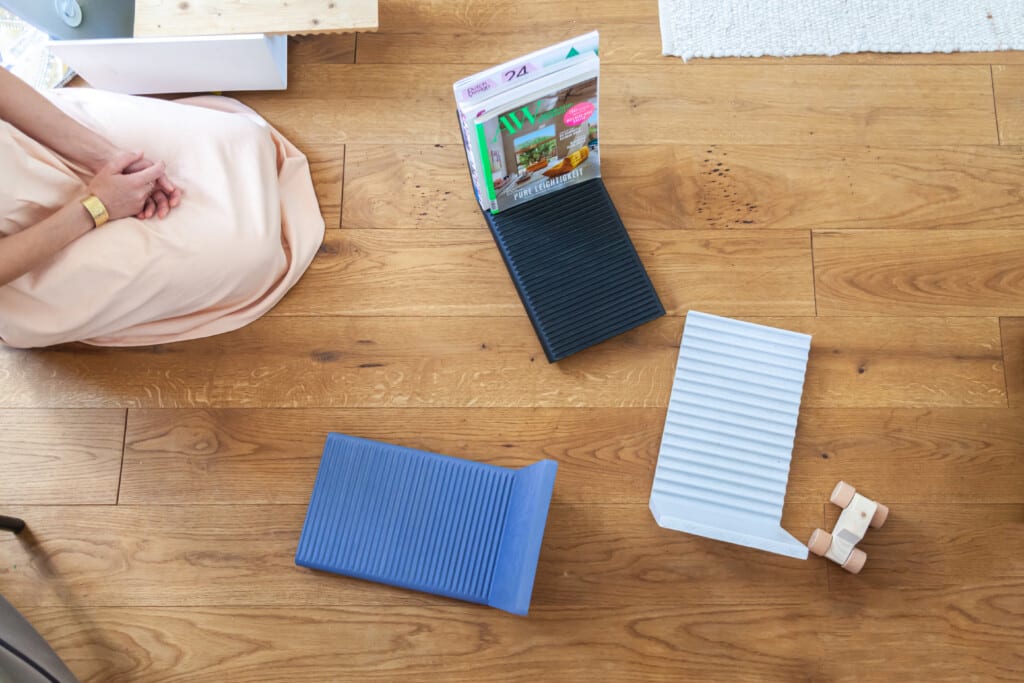
“There’s always some kind of chaos around you,” says Lisa. “Books and magazines end up where you use them: next to the sofa, in the kitchen or maybe even in the bathroom.” Rather than hiding those piles away in a bookcase, Papeterie gives them a place of their own, exactly where they are used.
The design sits somewhere between display and storage. The first book or magazine remains visible, while there is room for a small stack behind it. The object can stand on the floor next to a sofa, on a shelf or even inside a cabinet.
Drawing on his experience in interior architecture, Fynn looks at it from yet another angle. “In an interior, you always need objects that tell a distinct story, that bring something slightly different from everything around them. I think Papeterie can be that kind of object.”
At the same time, the solution is surprisingly simple. “It’s basically two planes set at an angle to each other with a small twist. Nothing more than that.”
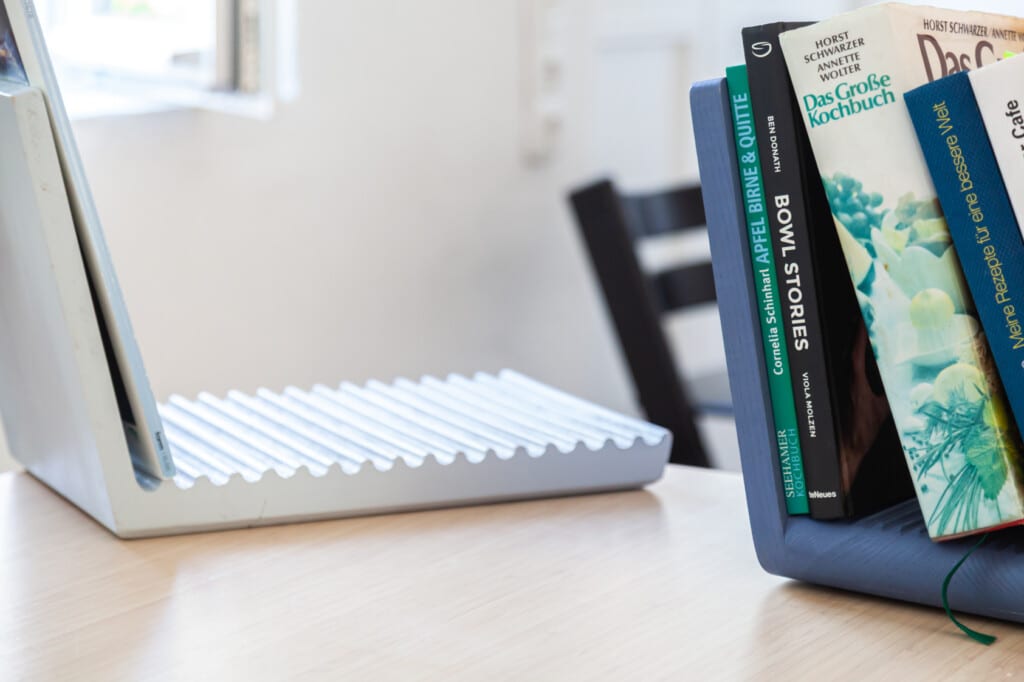
The first working model of Papeterie was standing in Lisa and Fynn’s home when Arjan and Anieke saw it. From that moment on, the design was developed further together. 3D models went back and forth, and different variations were tested straight away.
Together, they looked at material thickness, the angle of the planes and the proportions. The grooves that hold the books also changed throughout the process: they were more pronounced in the first models and became subtler in the final design. Another important detail was the generous rounding at the edges, which prevents the pattern from ending abruptly and instead makes it appear to fade gradually towards the edge.
Because designing and making were so closely connected throughout the collaboration, choices could be assessed immediately and adjusted again. The original idea remained intact, while the object became increasingly refined.
And yet the question remains: what exactly is Papeterie? It is not a bookcase, not a magazine rack, and not a conventional bookend either.
“Maybe the category simply doesn’t exist yet,” says Lisa.
Arjan and Anieke recognise something in that which occurs more often within the Vij5 collection: objects you did not know you needed beforehand. You might never have gone looking for them specifically, but once you see them, you can imagine exactly how they might find a place in your home. They have a practical function, while at the same time being able to stand as objects in their own right within an interior.


Designing in the midst of everyday life
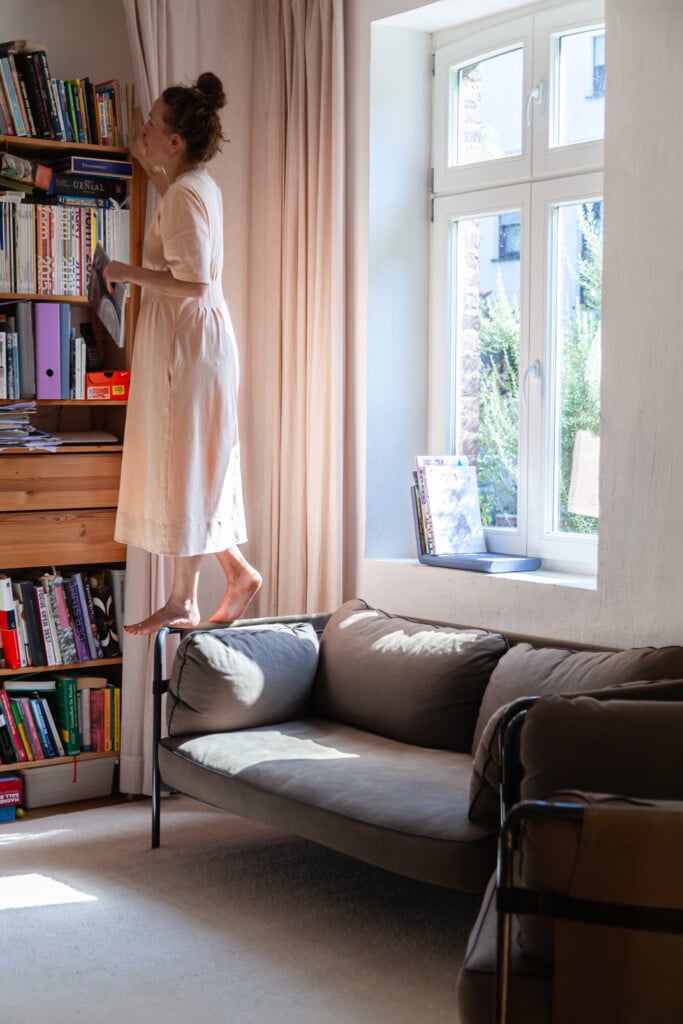
The fact that the first Papeterie prototype was discovered at home feels entirely fitting. For Lisa and Fynn, home is not only where family life unfolds; it is also where much of their design practice takes shape.
With two children, Lisa’s work as a lecturer at Hochschule Niederrhein and other projects, the time they can devote to KellerFreyschmidt together is limited. Entire days spent side by side in the studio are the exception rather than the rule.
“If there’s a real deadline, we arrange a babysitter so we can work very intensively together for a few hours,” says Fynn. Lisa describes their collaboration as happening in “short bursts”. “We almost never work on the same thing at the same time, sitting next to each other. One of us draws something, the other responds, then perhaps a 3D model or prototype is made, and it comes back again.”
The ping-pong game they use to describe their collaboration does not necessarily happen in a studio. More often, it takes place in between other work, children and everyday life.
Having children has forced Lisa and Fynn to use their time more efficiently. “If you know you have two hours, you work with complete focus for those two hours,” says Lisa.
Their children are literally growing up among prototypes and conversations about design. So the overlap between work and home life goes beyond time alone.


The future of KellerFreyschmidt
At the moment, KellerFreyschmidt is still often the work that happens in whatever time is left. That is something Lisa and Fynn want to change over the coming years.
“We want to create more space for our work together,” says Lisa. “Right now, we often do it in the little pockets of time that are left over. We want to make it a bigger part of our everyday lives and set clearer goals. As the children get older, that will become easier.”
There is certainly no shortage of ideas. Around the house and on the shelves, plenty of designs are waiting for the next step.
Whether their children eventually become designers themselves is not particularly important to Lisa and Fynn. More than anything, they hope they will keep their open, creative way of looking at the world. They can already see something of that in their four-year-old son. “He can listen to the same song twenty times in a row,” says Fynn. “He gets completely absorbed in trying to work out everything that is in it: first the drums, then the bass, and suddenly the electric guitar.” “He’s simply deconstructing it,” Lisa laughs. Her words draw a clear line back to Fynn, who loves to do exactly the same thing himself: take something apart, explore what it consists of, and use that as a starting point for looking further.
Their son’s curiosity fits beautifully with the way design has become such a natural part of life at home. The prototypes their children are growing up around are not there only to be tested; they are simply part of everyday life.
At KellerFreyschmidt, design is not separate from everyday life. It begins right in the middle of it.